Summer arrives and the same question lands in every parent group chat: how do we keep two months from disappearing into screens and boredom? For years the default answer was tuition. This year, a growing number of families are quietly choosing something different — coding camps.
There’s nothing wrong with extra academic support. But while tuition classes work to lift grades in subjects children already study, coding camps for kids point in a completely different direction — toward creativity, problem-solving, and the kind of future-ready skills that rarely fit inside a school timetable. Here’s why more parents are making the switch, and what children actually do inside a summer coding camp.
Why Parents Are Choosing Coding Camps Instead of Tuition
Tuition has its place. It can sharpen exam performance and reinforce the school syllabus. But summer is a rare window — a stretch of time that doesn’t have to look like more of the same. For most of the academic year, a child’s days are already accounted for:
- Studying for tests
- Completing homework
- Following a fixed school schedule
- Memorising information for exams
Summer offers the opposite: room to explore interests, discover hidden talents, and learn by doing. That’s exactly the space a coding summer camp is built to fill.
What Makes Coding Camps Different From Tuition?
Many parents reasonably ask whether a coding program is really more valuable than a few extra months of academic lessons. The difference comes down to what each one is designed to do.
Tuition Classes Focus on School Subjects
Tuition is usually built around improving grades in existing subjects, often using the same teaching style children already experience all year. It’s useful for academic support, but it rarely introduces new skills — or shows a child a career path they’d never considered.
Coding Camps Focus on Future Skills
Technology now runs through nearly every profession — medicine, engineering, business, architecture, science, design. Coding teaches far more than how to program. It builds logical thinking, creativity, communication, and the ability to break big problems into small, solvable steps.
Coding Camps Are Project-Based
The biggest difference is how learning actually happens. Where tuition leans on worksheets and practice questions, coding programs for kids are built around making things. Students finish the day with a game, a website, an app, or an AI project they can show off — not just a corrected answer sheet.
Coding Camps Help Children Discover Interests
Most children genuinely don’t know yet whether they’ll love robotics, AI, design, or building games. A STEM summer camp lets them sample several fields and find the one that clicks. It’s common for a child who never seemed interested in technology to suddenly light up over game development or robotics.
Tuition Classes
- Built around exams and grades
- Worksheets and revision
- Covers existing school subjects
- Relies on memorisation
- Academic improvement only
Coding Camps
- Built around real skills
- Hands-on projects and creativity
- Explores future technologies
- Develops problem-solving
- Skill-building and self-discovery
What Kids Actually Learn in a Coding Summer Camp
A common myth is that campers spend eight weeks hunched over walls of complicated code. Modern coding classes for kids look nothing like that — they’re interactive, hands-on, and project-led. Depending on age and interest, students can explore several different areas of technology.
Artificial Intelligence
AI is one of the fastest-growing fields on the planet, and children already use it daily without realising. Campers learn how AI tools really work, how to use them responsibly, and complete beginner-friendly projects that make advanced ideas click.
Explore the AI Hybrid course →Virtual Robotics
Virtual robotics turns engineering into play. Students learn how robots make decisions, follow instructions, and solve challenges through logic and code — with no expensive hardware required.
Explore robotics for kids →Python Programming
Python is one of the most widely used languages in the world. Campers build calculators, quizzes, chatbots, and small games while laying down strong coding foundations they can grow from.
Explore the Python program →App Development
Children discover how the apps on their phones are designed and built, then create simple applications of their own and explore how good apps solve real, everyday problems.
Web Development
Students learn how websites are built and how the internet works, then create their own web pages — experimenting with layout, structure, and design as they go.
Explore web development →3D Modelling
For creative learners, 3D modelling blends technology with art. Students design digital objects, characters, and environments while building spatial awareness and visual thinking.
Explore 3D modelling →The Junior Coderz 2-Month Summer Camp
At Junior Coderz, the goal isn’t simply to teach children to code — it’s to help them discover what they enjoy. Our 2-month online coding camp lets students explore different technology pathways based on their age, interests, and experience level. Campers can dive into:
Every student starts at their current level and builds confidence through real, hands-on projects. Younger campers often begin with block-based Scratch coding — and structured programs like Junior Inventors (ages 8–10) — before moving on, while older students dive straight into Python or AI. Most importantly, if a child loves it, they can keep going after the camp ends. And if they decide technology isn’t their path, they still walk away with valuable skills and a clearer view of the digital world.
Live Classes, Real Instructors
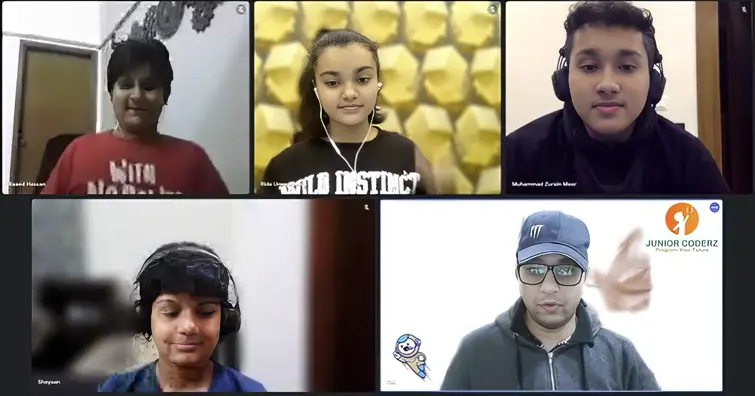
Junior Coderz classes are small and fully live — a handful of students working alongside one engineer instructor. That balance means every child gets real attention, asks questions freely, and stays genuinely engaged from the very first session.
- Small live groups
- Engineer-led instruction
- A real project in every session
What Happens After the Summer Camp Ends?
Plenty of parents worry their child will forget everything by September. In practice, the opposite tends to happen. Many students discover a specific area they love and choose to keep learning — some stick with Python, others move deeper into AI, robotics, web, or app development. The summer camp simply hands them a direction to grow in.
Worried about screen habits in general? Our guide to productive alternatives to YouTube for kids covers the same shift — from passive watching to active creating. And if your child is hesitant at first, here’s how to help them learn coding without pressure.
Should You Choose a Coding Camp or Tuition This Summer?
If your child specifically needs help with school subjects, tuition is a sensible choice. But if your hope for the summer is bigger than grades — if you want your child to:
- Learn future-ready skills
- Explore technology hands-on
- Build genuine confidence
- Strengthen creativity
- Sharpen problem-solving
- Discover brand-new interests
— then a coding summer camp may offer far more lasting value. And it isn’t a trade-off between learning and fun. The best summer camps for kids deliver both at once.
Give Your Child a Summer That Builds Real Skills
Summer passes quickly. The real question is whether those two months simply vanish — or become a season of growth. Through live coding classes, real technology projects, and hands-on learning, children gain skills that keep paying off long after summer ends.
Not sure if it’s the right fit? Start with a free trial class and let your child experience it before you decide.
Book a Free Trial ClassLooking Ahead
More families are choosing coding camps because they offer something traditional tuition often can’t: the chance to learn by creating. Whether a child spends the summer exploring artificial intelligence, Python, robotics, app development, or web development, an online coding camp can turn a long break into a genuinely meaningful experience — without sacrificing any of the fun.
For more ideas on keeping kids engaged over the break, see our guide to choosing the right summer program for your child.
Frequently Asked Questions
Yes. A good coding camp helps children develop problem-solving, creativity, logical thinking, and confidence — all while building real projects they’re proud of. Unlike passive screen time, those skills tend to stick well beyond the summer.
Many children can start as early as 6–7 using beginner-friendly tools like Scratch and block-based coding. From there, programs scale up to Python, AI, and beyond as children grow and gain confidence.
Depending on age and interest, students explore artificial intelligence, robotics, Python, app development, web development, 3D modelling, and more — usually through hands-on projects rather than lectures.
Yes. Modern online coding camps combine live instruction, interactive projects, and personalised support, so students stay engaged and actually retain what they learn.
Students can continue into more advanced courses, keep building personal projects, or go deeper into whichever technology they enjoyed most during the camp.