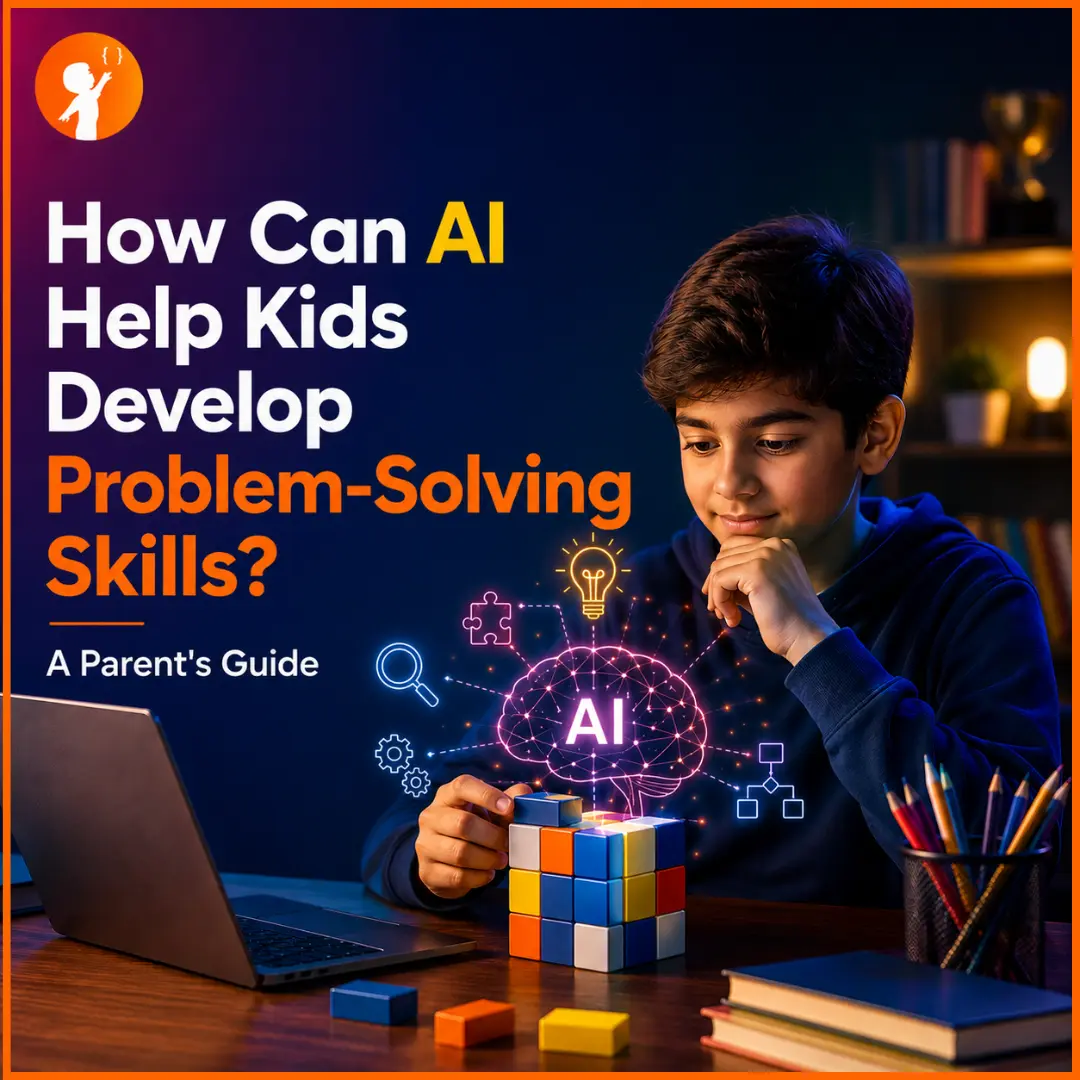
Ask any teacher, employer, or parent what the single most important skill is for a child’s future, and you’ll hear the same answer again and again: problem-solving. It’s the skill behind every subject, every job, and every good decision — and this is exactly where AI helps in problem solving in two powerful ways.
First, AI is one of the greatest problem-solving tools humanity has ever built, quietly tackling real-world challenges every day. Second, when kids learn how AI works, they build sharper problem-solving skills of their own. In this guide, we’ll explore both. If you’re new to the topic, our beginner’s guide to AI for kids is a great starting point.
What Is Problem-Solving in Artificial Intelligence?
Let’s start simple. Problem-solving in artificial intelligence means using a computer to work through a challenge and reach the best possible answer — often faster or more accurately than a human could. Instead of being told exactly what to do step by step, an AI learns from huge amounts of information, spots patterns, and uses those patterns to make decisions or predictions.
Think of it like this: a human learns that a stove is hot by touching it once. An AI “learns” by looking at thousands of examples until it can reliably tell what’s likely true. That ability to learn from data and apply it to new situations is the heart of how AI solves problems.
How Does AI Actually Solve Problems?
You don’t need to be a scientist to understand the basics. Most AI solves problems in a few simple stages:
- It gathers data. AI needs examples to learn from — photos, numbers, text, sounds, or all of these.
- It finds patterns. The AI studies that data and notices patterns a human might miss, like the tiny details that separate a healthy cell from a sick one.
- It makes a prediction or decision. Based on those patterns, it gives its best answer — what an object is, what word comes next, or which route is fastest.
- It improves over time. The more good data it sees, the better it gets. This is called machine learning.
Real-World Problems AI Helps Solve
The best way to understand AI’s problem-solving power is to see it in action. Here are real-world problems AI is helping solve right now — many of which your child already benefits from:
| Area | A Problem AI Helps Solve |
|---|---|
| Healthcare | Spotting diseases early by analysing medical scans faster than the human eye |
| Weather & climate | Predicting storms and tracking climate change using huge amounts of data |
| Transport | Powering self-driving features that help cars avoid accidents |
| Accessibility | Helping people who are blind or deaf through image descriptions and live captions |
| Language | Translating between languages instantly so people can understand each other |
| Daily life | Recommending videos, answering questions, and filtering spam emails |
| Environment | Helping farmers grow more food while using less water and fewer chemicals |
How Learning AI Improves Problem-Solving Skills in Kids
Here’s where it gets exciting for parents. Learning how AI works doesn’t just teach kids about technology — it trains their brains to think the way great problem-solvers do. Here’s how.
1. It Teaches Kids to Break Big Problems into Small Steps
AI works by splitting a huge challenge into smaller, solvable pieces — and kids learn to do the same. This skill, called computational thinking, helps them tackle everything from maths problems to messy real-life situations without feeling overwhelmed.
2. It Builds Logical, Cause-and-Effect Thinking
To make AI work, kids have to think in clear, logical steps: “if this happens, then that should follow.” This strengthens the exact kind of reasoning they’ll use in science, maths, and everyday decisions for the rest of their lives.
3. It Makes Failure a Normal Part of Learning
When a child’s AI project or code doesn’t work, they have to figure out why and try again — a process called debugging. Instead of fearing mistakes, they learn that failure is just information, and persistence pays off. Our guide on the best AI projects for kids is full of hands-on ways to practise this.
4. It Encourages Creative Solutions
There’s rarely just one way to solve a problem with AI. Kids learn to experiment, compare approaches, and invent creative solutions — a flexible, open-minded way of thinking that helps far beyond the computer.
5. It Strengthens Focus and Persistence
Building something with AI takes patience. As kids stick with a project and finally see it work, they build the focus and grit that make them better problem-solvers in every part of life — school, hobbies, and beyond.
Beyond Problem-Solving: The Wider Benefits of AI for Kids
Problem-solving may be the biggest benefit, but it’s not the only one. Learning AI also gives children a head start on future careers, boosts their confidence and creativity, and helps them understand — and safely navigate — the technology shaping their world. Whether your child starts with coding or AI first, these are skills that pay off in almost every subject and job. In short, the benefits of AI for kids go far beyond tech: they build sharper, braver, more capable thinkers.
How to Help Your Child Build Problem-Solving Skills with AI
You don’t need to be a tech expert to get your child started. Here’s a simple path:
- Start with curiosity. Point out how AI solves everyday problems — recommendations, voice assistants, maps — and ask “how do you think that works?”
- Let them create, not just consume. Encourage hands-on projects where they build something with AI, rather than just using apps.
- Add coding as they grow. Coding is the language behind AI and one of the best problem-solving workouts there is.
- Try real challenges. As they gain confidence, activities like AI competitions push their problem-solving even further.
- Get expert guidance. A structured online AI course keeps kids progressing instead of getting stuck. Our guide on how to teach AI to kids has more ideas too.
How Junior Coderz Turns AI into Real Problem-Solving Skills
At Junior Coderz, this is exactly what we do. We don’t just teach kids about AI — we teach them to build with it, because that’s how real problem-solving skills are formed. Through our structured AI and machine learning classes and our 18-month AI Hybrid Course, students work on real projects — the kind where they break down problems, test ideas, fix what doesn’t work, and celebrate what does.
Every class is led by expert engineer trainers who guide each child at their own pace, and our full range of courses means there’s a starting point for every level and interest. Curious whether it’s the right fit? Book a free trial class and watch your child’s problem-solving confidence grow, or explore all our courses to find the perfect starting point.

Start Building Smarter Thinkers Today
AI is changing the world by solving problems we once thought impossible. But the real magic for your child isn’t just using AI — it’s learning to think like a problem-solver, a skill that will serve them for life. Every big challenge they’ll face comes down to the ability to break it down, stay curious, and keep going.
The best time to start building that skill is now. Explore how Junior Coderz helps kids turn curiosity about AI into real, lasting problem-solving power.
Frequently Asked Questions
Learning how AI works trains kids to break big problems into small steps, think logically, and learn from their mistakes. Those are the exact habits strong problem-solvers rely on, in every subject and career.
Give them real challenges to work through, encourage creating over just consuming, and let mistakes be a normal part of learning. Hands-on activities like coding and AI projects build these skills far faster than worksheets.
A commonly used version is Clarify, Consider, Choose, Commit, and Check — define the problem, weigh the options, pick a solution, act on it, then review how it went. It gives kids a simple, repeatable way to tackle any challenge.
AI helps detect diseases early, predict weather, power self-driving features, translate languages, support people with disabilities, and filter spam. It’s already solving problems across healthcare, transport, the environment, and everyday life.