Artificial intelligence is no longer a future skill — it’s part of the world your child is growing up in right now. So it’s no surprise that more parents are searching for the best AI course for kids online. But with so many options, from free tools to full guided programs, how do you know which one is actually right for your child?
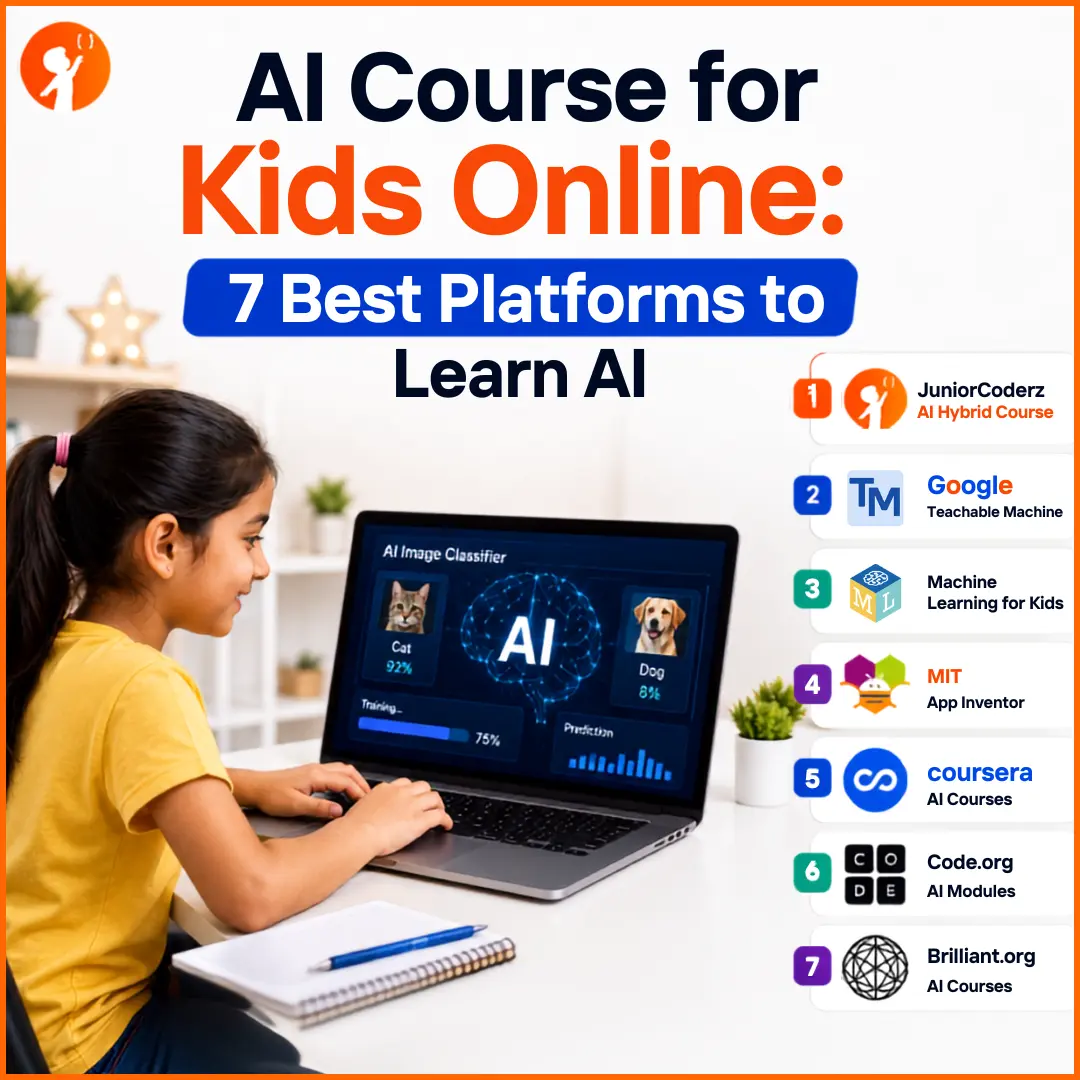
This guide compares the 7 best AI platforms for kids in 2026 — free and paid — with honest pros, cons, and age recommendations. The short version: free tools are great for quick exploring, while a guided course with a real teacher is best if you want steady progress.
What Should Parents Look for in an AI Course?
Choosing an online AI course for kids isn’t simply about finding the biggest name. A good course should help children understand how AI works while keeping learning enjoyable through projects and real activities. Before enrolling, weigh these features.
| Feature | Why It Matters |
|---|---|
| Live Classes | Children stay engaged by interacting with instructors and asking questions. |
| Project-Based Learning | Kids learn faster when they build chatbots, games, or AI projects themselves. |
| Age-Appropriate Curriculum | Lessons should match the child’s learning level and interests. |
| Expert Teachers | Experienced instructors make complex ideas much easier to understand. |
| Coding Integration | Learning Python alongside AI builds a stronger technical foundation. |
| Real AI Projects | Practical experience helps children apply what they learn. |
| Progress Tracking | Parents can monitor improvements and celebrate achievements. |
Quick Comparison: The 7 Best AI Platforms at a Glance
| Platform | Age | Live Classes | Free Version | Best For |
|---|---|---|---|---|
| Junior Coderz AI Hybrid Course | 8-16 | Yes | Free trial | Guided, mentor-led learning |
| Google Teachable Machine | 8+ | No | Yes | Machine learning experiments |
| Machine Learning for Kids | 8+ | No | Yes | Scratch + AI projects |
| MIT App Inventor | 12+ | No | Yes | AI mobile apps |
| Coursera AI Courses | 15+ | Mostly recorded | Partial | AI concepts |
| Code.org AI Modules | 10+ | No | Yes | School learning |
| Brilliant.org | 13+ | No | Partial | AI theory & problem solving |
The 7 Best AI Courses for Kids (Detailed Look)
Every child learns differently, so there isn’t one perfect platform. Here’s a closer look at each — what it teaches, its strengths, and the type of learner it suits best.
Junior Coderz’s 18-month program teaches AI through live, instructor-led classes. Students progress from Python into AI and machine learning while building real projects — with web development, app development, and virtual robotics along the way, plus regular coding competitions to keep things motivating.
- Live classes with expert engineer trainers
- Structured 18-month path with hands-on projects
- Free trial class before you enrol
- Requires consistent weekly participation.
Want to see if it’s the right fit? Watch a student walk through their own project above — then try it for yourself.
Book a Free Trial ClassGoogle Teachable Machine
A free, browser-based tool that lets kids train AI models from images, sounds, or body poses and instantly see machine learning in action — no coding required. Perfect for a first “wow” moment.
- Completely free
- No coding needed
- Works right in the browser
- Not a full course — limited structure and projects
Machine Learning for Kids
Combines Scratch with simple machine learning, so kids build games and interactive projects that use AI without needing advanced programming. A friendly bridge between block coding and real AI.
- Beginner-friendly and creative
- Free version available
- Great for younger learners
- Mostly Scratch-based — older kids may outgrow it
MIT App Inventor
A drag-and-drop platform for making Android apps, with AI extensions for image recognition, chatbots, and speech features. Kids end up with an app they can actually use.
- Free and builds real mobile apps
- AI extensions included
- Large learning community
- Steeper learning curve and Android-only
Coursera AI Courses
University-created AI courses delivered mostly through recorded lessons and quizzes. Motivated teenagers can explore solid AI concepts at their own pace before moving into practical work.
- University-quality content
- Learn at your own pace
- Completion certificates
- Mostly video, with little instructor interaction
Code.org AI Modules
Free, classroom-friendly lessons that explain how AI works and how to use it ethically, through short interactive activities. A gentle on-ramp before a structured AI course for kids online.
- Completely free and beginner-friendly
- Interactive lessons
- Trusted by schools worldwide
- Short modules and less project-focused
Brilliant.org
Teaches AI and computer science through interactive problem-solving rather than videos, so students learn by working through challenges and seeing the logic for themselves.
- Highly interactive
- Builds critical thinking
- Well-designed lessons
- Subscription needed, and more theory than building
How to Choose the Right AI Course for Your Child
With seven solid options, the “best” one really comes down to your child and your goals. Here’s a simple way to decide:
- Start with your goal. Quick exploring? A free tool like Teachable Machine is perfect. Want lasting progress? Choose a guided course.
- Match it to age and level. A complete beginner needs a different starting point than a child who already codes — and AI classes for 10 year old kids should look different from courses for teens.
- Self-paced or live teacher? Be honest about your child — many kids stall on self-paced tools without accountability, while a live mentor keeps them moving.
- Check for hands-on projects. Kids learn AI by building, so avoid courses that are all watching and no doing — these AI projects for kids show the kind of building to look for.
- Try before you commit. Most options offer a free trial or free tier — use it, including a free trial class, before paying for anything.
Can Kids Learn AI Without Coding?
Yes — tools like Teachable Machine let kids explore AI with little or no code, a great first step. But real-world AI needs coding, especially Python for kids, the language behind most AI today. The best path: start with no-code tools, then help kids learn coding so they create instead of just click — soon they can even build a simple Python AI chatbot.
That’s why Junior Coderz teaches AI alongside a full range of skills — Python, robotics, web and app development, and more. Curious why coding still matters? See how to teach AI to kids and AI vs coding for kids.
Start Your Child’s AI Journey Today
Artificial Intelligence is becoming a valuable skill for tomorrow’s workforce. Giving children the chance to understand AI today helps them become confident creators, not just technology users.
At Junior Coderz, students don’t just learn about AI — they build with it, progressing from Python to machine learning, robotics, web development, and real AI projects in live online classes. If you’re unsure where your child should begin, you can browse our courses or book a free trial class first.
Final Thoughts
Finding the best AI course for kids online isn’t about choosing the platform with the most features — it’s about choosing the one that matches your child’s learning style and goals. Free tools are excellent for experimenting, while structured programs like those at Junior Coderz help students develop lasting skills through projects and expert guidance.
Frequently Asked Questions
The best course depends on your child’s age and goals. If you want a structured program with live classes, real projects, and expert guidance, the Junior Coderz AI Hybrid Course is a strong option for teenagers.
Popular platforms include Google Teachable Machine, Machine Learning for Kids, MIT App Inventor, and Code.org. Each introduces AI in a beginner-friendly way through interactive activities.
Not necessarily. Children can begin exploring AI concepts without coding, but learning programming later — especially Python — helps them understand how AI systems are actually built.
Python isn’t required to explore beginner AI tools, but it is the most widely used language for AI. Learning Python gives students a strong foundation for advanced AI projects.
Yes. Good AI classes for kids teach much more than technology — they build creativity, logical thinking, and problem-solving. Junior Coderz’s 18-month AI Hybrid Course combines AI, Python, robotics, web development, and hands-on projects to prepare students for the future while keeping learning engaging.