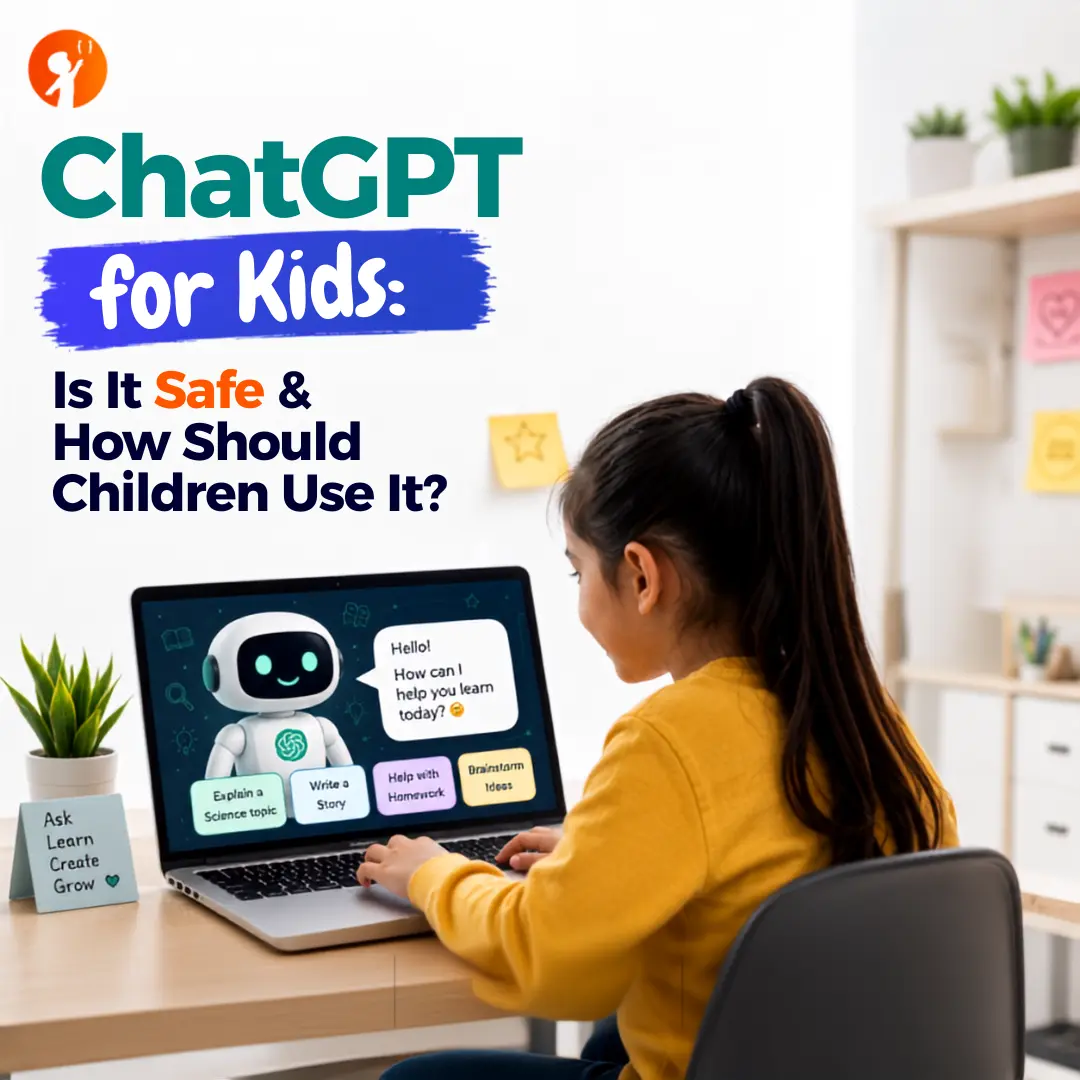
If your child hasn’t already asked ChatGPT a question, chances are they soon will. It writes stories, explains homework, and answers almost anything in seconds — and kids are naturally curious. So the question on every parent’s mind is simple: is ChatGPT for kids actually safe, and how should children use it?
The honest answer: it depends on your child’s age and how it’s used. With the right guidance, ChatGPT can be a helpful learning tool for teens. Used unsupervised by younger children, it carries real risks. This guide breaks down exactly what ChatGPT is, the benefits, the risks, the official age rules, and practical steps to keep your child safe.
What Is ChatGPT? (A Simple Explanation for Parents)
ChatGPT is a generative AI chatbot made by a company called OpenAI. In plain terms, it’s a computer program you can talk to in everyday language — you type a question or request, and it writes back an answer, an explanation, a story, or an idea almost instantly. Generative, simply means it creates new content rather than pulling up a fixed page like a search engine does.
What makes it feel different from anything kids have used before is how human it sounds. It can hold a back-and-forth conversation, remember what was said earlier in the chat, adjust its tone, and explain the same thing five different ways if asked.
| Quick Facts | Details |
|---|---|
| What it is | A generative AI chatbot that answers questions and creates text |
| Made by | OpenAI |
| Minimum age | 13 (teens 13–17 need parental consent) |
| Kids version? | No — there is no official ChatGPT made for children |
| Cost | Free version available, plus paid plans |
| Best used by kids | Older teens, with supervision and clear rules |
Is ChatGPT Safe for Kids Under 13?
This is the question that matters most: ChatGPT is not designed for, or permitted for, children under 13. OpenAI’s own rules set the minimum age at 13, and there is no official kids version. The tool was built for adults, so its tone, answers, and the content it can produce simply aren’t calibrated for young children.
- It treats every user the same. A 10-year-old gets the exact same responses a 30-year-old does — and that’s a problem for the 10-year-old.
- There’s no official kids version. Be wary of third-party apps marketed as “ChatGPT for kids”; many are just wrappers around the same adult tool.
- Filters aren’t foolproof. OpenAI itself admits the safety guardrails can weaken over a long conversation.
- Safer alternatives exist. For under-13s, a supervised intro to AI for kids or a guided AI course suits their age far better.
Benefits of Using ChatGPT for Kids
When used appropriately — by teens, with guidance — ChatGPT can genuinely support learning and curiosity. Here’s where it shines.
1. It Explains Tricky Topics in Simple Words
ChatGPT can take a concept a child is struggling with — long division, photosynthesis, why the seasons change — and re-explain it in language they actually understand. If the first explanation doesn’t click, your child can type “can you explain that more simply?” or “use a football example,” and it instantly adapts.
2. It Sparks Curiosity
Children are full of why and how questions — why is the sky blue, how do planes stay up, what would happen if there were no gravity? ChatGPT gives them a safe, judgement-free place to ask endlessly, and one answer often leads to the next question. Parents can make the most of this by turning a ChatGPT answer into a real-world activity.
3. It Boosts Creativity
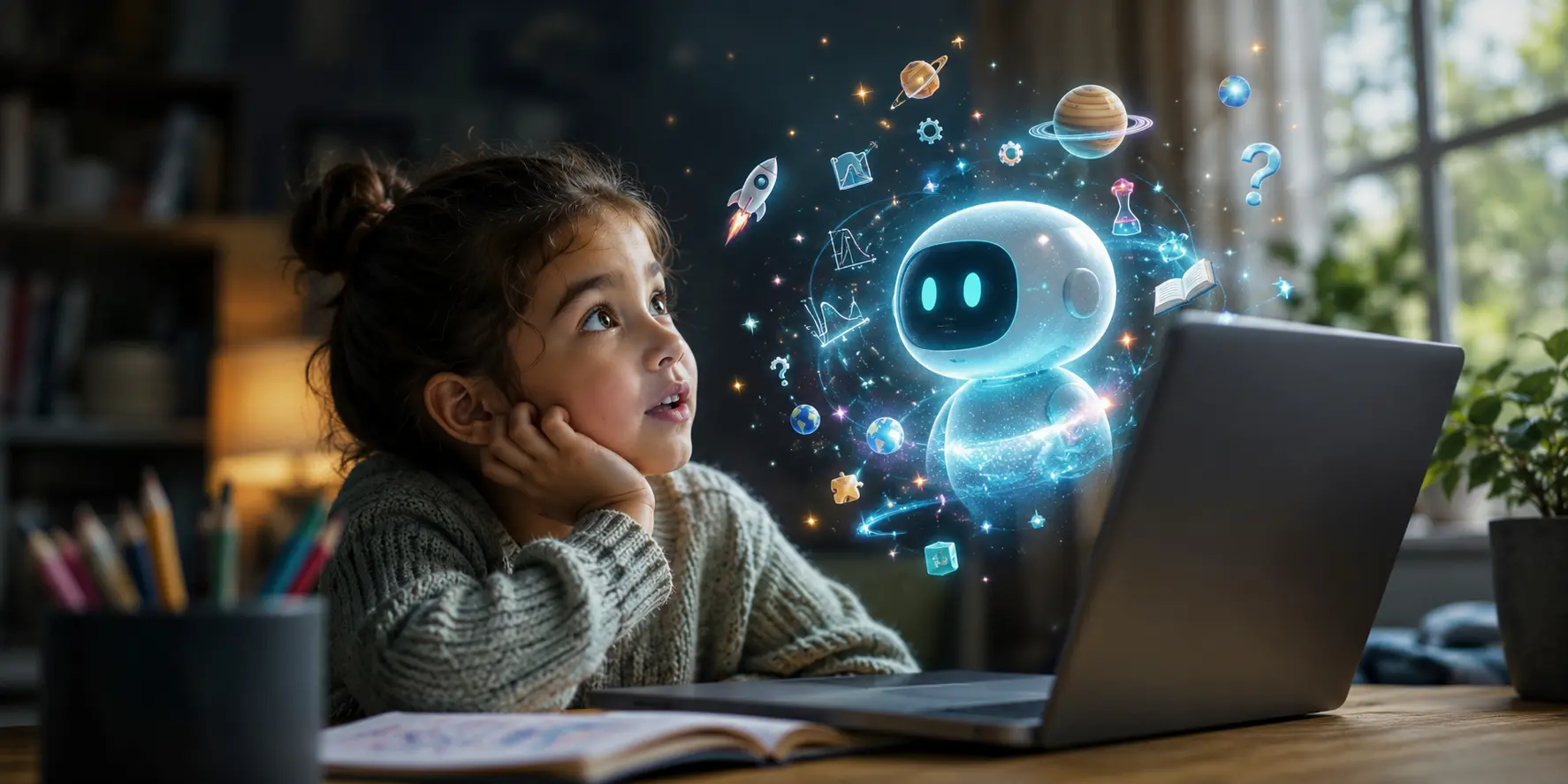
Whether it’s brainstorming story ideas, suggesting angles for a science-fair project, or helping a child get past the dreaded blank page, generative AI for kids can act as a creative partner. A child stuck on how to begin an essay might ask for three possible opening lines, pick the one they like, then write the rest entirely themselves.
4. It Builds AI Literacy
Understanding how tools like ChatGPT actually work is quickly becoming as fundamental as knowing how to use the internet. Children who learn what AI can and can’t do — and how to ask it good questions — are building a skill that will matter in almost every future career. Our guide on how to teach AI to kids explores this in much more depth.
5. It Supports Different Learning Styles
No two children learn the same way, and ChatGPT is endlessly flexible. It can rephrase an explanation, turn it into a step-by-step list, offer a real-world analogy, or generate a quick practice quiz — all on demand. A visual thinker can ask for a comparison they can picture; a child who needs repetition can ask the same question five ways without ever feeling embarrassed.
What Are the Real Risks of ChatGPT for Kids?
ChatGPT isn’t dangerous the way a stranger online is, but it has real downsides parents shouldn’t ignore. Knowing them is what lets you set the right boundaries.
1. It Can Be Confidently Wrong
One of ChatGPT’s biggest weaknesses is that it sometimes invents facts, dates, names, or sources that sound completely convincing — a problem known as hallucination. It rarely says “I’m not sure”; it just answers with total confidence. Teach your child to treat ChatGPT as a starting point, not the final word, and to double-check anything important.
2. It Can Show Age-Inappropriate Content
Because ChatGPT was built for adults, it can produce content that isn’t suitable for children. It does have safety filters, but OpenAI openly acknowledges those guardrails aren’t foolproof and can weaken over the course of a long conversation.
3. It Can Encourage Over-Reliance
When answers arrive instantly and effortlessly, it’s tempting for kids to lean on ChatGPT for everything. A child who asks AI to write their essay learns far less than one who wrestles with the messy middle themselves.
4. Privacy and Emotional Concerns
Conversations may be stored and, on the free version, used to help improve AI models — so children should never share personal details such as their full name, school, address, phone number, or photos. After serious safety concerns came to light in 2025, OpenAI introduced new protections, including a system that can notify parents if it detects possible signs that a teen may be at risk.
How to Make ChatGPT Safer for Kids and Teens
Keeping kids safe with AI isn’t about banning it — they’ll encounter it everywhere, from school to their friends’ phones. It’s about building healthy habits early. A few simple ground rules at home make a big difference:
- Use it together, especially at first. Sit beside your child and explore AI side by side for a while.
- Keep devices in shared spaces. Open, in-the-living-room use is far safer than closed-door, unsupervised access.
- Talk openly, don’t just monitor. Ask what they’re using AI for and what they’ve discovered — honest conversations reveal far more than secret surveillance.
- Choose creating over consuming. Steer screen time toward building and learning rather than passive scrolling — these alternatives to YouTube help kids create instead of just watch.
- Set up ChatGPT’s parental controls. Since late 2025, parents can link their account to their teen’s (13–17) to set quiet hours, turn off voice and image features, switch off memory, and opt conversations out of training.
Help Your Child Use AI the Smart Way
The safest way for a child to engage with AI isn’t to hand them an unsupervised chatbot and hope for the best. It’s to help them understand how AI works, so they grow into thoughtful creators who can question, guide, and build with it.
That’s exactly what we do at Junior Coderz. Our expert engineer trainers teach kids and teens to use AI responsibly and even build their own projects, through our AI and machine learning classes and our 18-month AI Hybrid Course. Curious whether it’s the right fit? Book a free trial class, or browse all our courses.
Looking Ahead
ChatGPT and generative AI aren’t going anywhere — they’ll be woven into your child’s education, hobbies, and future career. The goal isn’t to fear the technology, but to guide your child to use it wisely. With the right AI education and steady support, your child can grow into a confident, capable, and safe user of the tools that will shape their world — and even build their own AI projects. Explore how Junior Coderz helps kids get there across a full range of skills, one guided step at a time.
Frequently Asked Questions
For teens aged 13+, it can be reasonably safe with parental consent, parental controls, and supervision. For children under 13, it’s not recommended — supervised, age-appropriate tools and guided AI classes are a safer choice.
Officially, no. OpenAI sets the minimum age at 13, so a 10-year-old shouldn’t have independent access. If they’re curious about AI, a supervised, kid-appropriate tool or a guided class is far better suited to their age and stage.
No. As of 2026, OpenAI has not released a kids-specific version. Be cautious of third-party apps marketed as “ChatGPT for kids” — many are just wrappers around the same adult tool.
Yes. Since late 2025, parents can link their account to a teen’s (13–17) to set quiet hours, disable certain features, opt out of model training, and receive safety alerts.
The minimum age is 13. Teens aged 13–17 need parental consent, and children under 13 are not permitted under OpenAI’s terms of service.