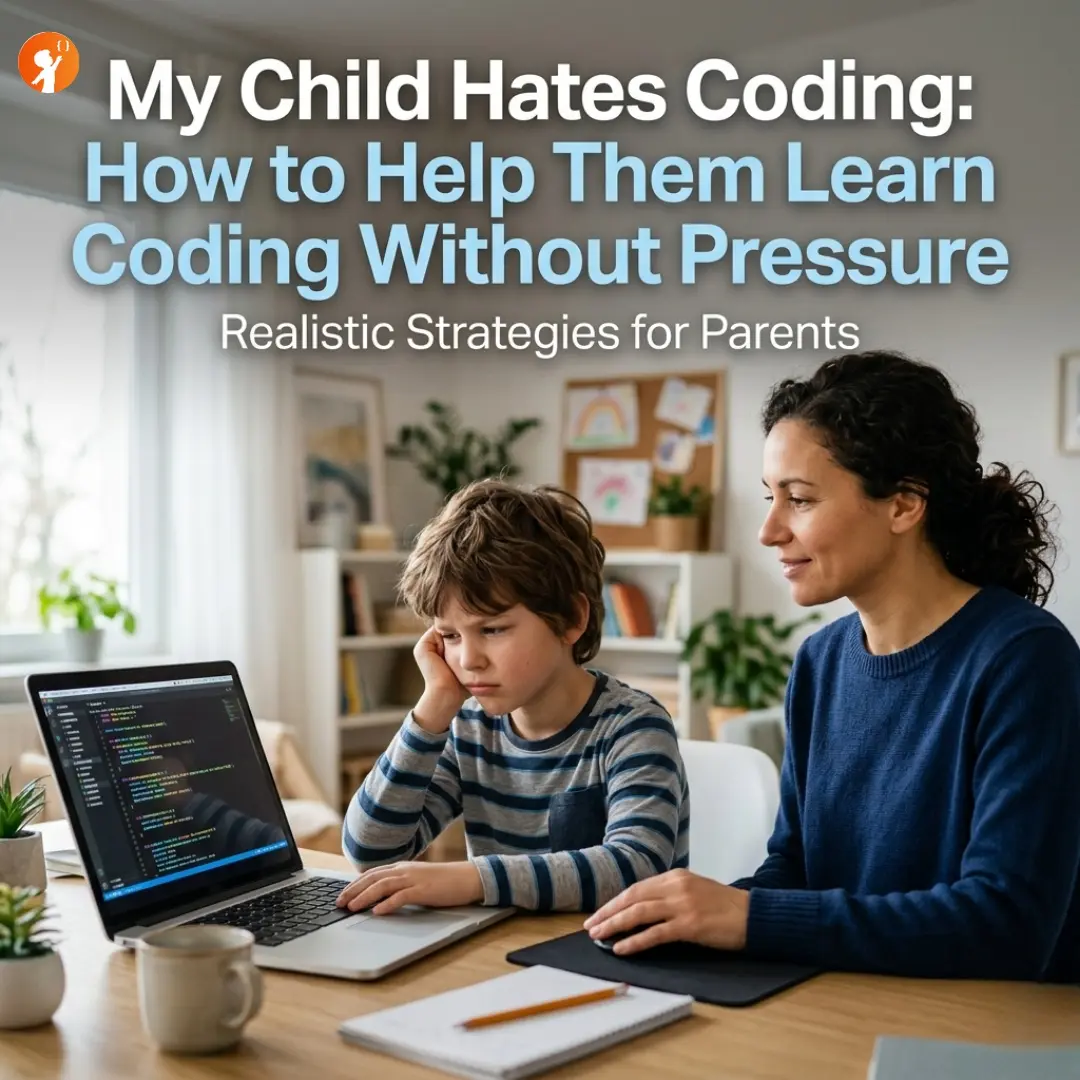
Have you ever signed your child up for a coding class only to hear, “I don’t like coding” after a few lessons? If so, you’re not alone. Many parents want their children to learn coding, but become worried when their child loses interest or refuses to continue.
The good news is that in most cases, the problem is not coding itself. Often, children are introduced to coding in the wrong way, at the wrong level, or through activities that don’t match their interests. Before giving up on coding classes for kids, let’s understand why some children struggle and what parents can do to make the experience enjoyable.
Why Does My Child Hate Coding?
When parents search for terms like child hates coding or child not interested in coding, they often assume coding simply isn’t for their child. However, there is usually a deeper reason.
Some children find coding too difficult, while others find it boring because they don’t get to create anything exciting. Sometimes the course moves too quickly, and sometimes it focuses too much on theory rather than hands-on projects.
| Reason | What the Child Feels |
|---|---|
| Too difficult | “I can’t understand this.” |
| Too advanced | “I’m confused.” |
| Too boring | “This isn’t fun.” |
| Not creative enough | “I’d rather make something.” |
| Wrong learning style | “This isn’t for me.” |
Understanding the real reason behind your child’s frustration is the first step toward helping them enjoy technology again.
Not Every Child Learns Coding the Same Way
One of the biggest mistakes adults make is assuming that every child should learn coding in exactly the same way. Some children love building games. Others enjoy drawing, storytelling, robotics, AI, or creating apps. A child who dislikes one type of coding may absolutely love another.
This is why successful kids learning coding programs allow students to explore different areas before choosing a path. At JuniorCoderz, popular learning paths include:
The goal is not to force coding but to help children discover what excites them.
The Biggest Mistake Parents Make When Teaching Coding
Many parents know technology is important, but sometimes they accidentally create pressure around it.
Common Mistakes to Avoid
- Forcing children to learn coding because everyone else is doing it
- Comparing them with friends or siblings
- Expecting fast results
- Choosing a course based on popularity instead of interest
- Focusing only on future careers instead of enjoyment
What Works Instead
- Let children explore at their own pace
- Celebrate their unique progress
- Focus on the process, not just the outcome
- Match the course to the child’s interests
- Prioritize curiosity and creativity
Coding should feel like exploration, not another school subject. Children learn best when they are curious and excited to create something on their own. If you’re wondering what to expect from your child’s initial coding classes, the focus should always be on engagement, not pressure.
5 Ways to Make Coding Fun Again
If your child has lost interest, don’t worry. Here are five practical ways to make coding fun again.
Start with Scratch and Block Coding
Many children struggle because they begin with text-based programming too early. Scratch allows children to create games, animations, and stories using colorful blocks instead of typing complicated code. Building fun games with block coding often feels more like playing than learning — kids can create racing games, obstacle games, and interactive stories while learning important concepts. For example, students can build games like this popular Scratch project and see how coding translates into something real.
Build Real Projects with Python
As children become more confident, they can move into Python and start building useful projects. Instead of learning random concepts, they can create calculators, quiz games, chatbots, and many other beginner-friendly projects. Working on simple Python projects helps children see the real purpose of coding and keeps them motivated to continue learning.
Choose Age-Appropriate Learning
A six-year-old and a fourteen-year-old should not be learning the same way. Younger children usually enjoy visual coding and creative activities, while older students are often ready for Python, AI, or web development. Choosing the right level reduces frustration and helps children build confidence from the start.
Celebrate Small Wins
Many children quit because they feel they aren’t making progress. That’s why small achievements matter. Finishing a game, solving a challenge, or creating a simple project should be celebrated. These small wins build confidence and encourage children to keep learning.
Explore AI, Robotics, and App Development
Sometimes a child doesn’t dislike coding — they simply haven’t found the right technology area yet. Many students who aren’t interested in traditional coding become excited when they explore AI learning opportunities, robotics projects, mobile app creation, or web development. Giving children choices often leads to greater motivation. Some students even go on to participate in coding competitions and discover a passion they never expected.
How JuniorCoderz Helps Children Learn Coding Without Pressure
At JuniorCoderz, we understand that every child learns differently. That’s why our courses are designed around a student’s age, experience level, and interests. Instead of placing every student into the same program, we help them explore different technology areas and discover what they enjoy most.
Students don’t just watch lessons — they actively build games, apps, websites, AI projects, and creative technology solutions from day one.
Our trainers guide students through hands-on activities, real projects, and engaging challenges that make learning feel natural rather than forced.
Every course is matched to the student’s age and experience level, so children never feel overwhelmed or held back.
Children can explore different technology paths — Scratch, Python, AI, robotics, app development, web development — and choose what excites them most.
We offer a free trial class so parents can see how their child responds before making any commitment. Sometimes all it takes is the right environment to turn a reluctant learner into an enthusiastic creator.
What Is the Best Coding Language to Learn?
Many parents ask about the best coding language to learn. The answer depends on age and experience level.
| Age | Recommended Starting Point |
|---|---|
| 6–8 | Scratch |
| 8–10 | Scratch + Logic Building |
| 10–13 | Python |
| 13+ | Python, AI, Web Development |
For most beginners, Python is an excellent choice because it is simple, beginner-friendly, and used in real-world applications like AI, automation, and software development.
JuniorCoderz 2-Month Summer Camp
If your child is unsure about coding, summer can be the perfect time to explore different technology skills without pressure. The JuniorCoderz 2-Month Summer Camp allows students to try a variety of exciting courses.
What Students Explore During Summer Camp
The goal isn’t to force children into a long-term commitment. Instead, students get the opportunity to explore, learn, and discover what they enjoy. If they love the experience, they can continue learning afterward. If not, they still gain valuable skills and exposure to technology.
What If My Child Still Isn’t Interested?
That’s completely okay. Not every child will enjoy coding immediately, and some may discover their passion in a different area of technology. The important thing is to keep learning fun and avoid turning it into a source of stress.
Give your child opportunities to explore, experiment, and create. Often, interest develops naturally once they find the right project, trainer, or technology field. There’s no rush — the goal is to build a positive relationship with technology, not to force a specific outcome.
Let Your Child Explore Technology Without Pressure
The best way to know whether coding is right for your child is to let them experience it. At JuniorCoderz, children can explore coding, AI, robotics, web development, app creation, and many other technology skills through engaging projects and supportive instruction. There is no pressure — just an opportunity to learn, create, and discover new interests.
Book a free trial class today and let your child decide whether coding is something they enjoy. Sometimes one exciting project is all it takes to spark a lifelong interest.
Book Your Free Trial ClassLooking Ahead
Helping children learn coding is not about forcing them to become programmers. It’s about giving them opportunities to explore technology, build confidence, and discover their interests. With the right support, engaging projects, and guidance from JuniorCoderz, even children who once disliked coding can learn to enjoy creating with technology.
FAQs
Many children struggle because they are learning concepts that are too advanced for their current level. Starting with beginner-friendly projects and age-appropriate lessons often makes coding much easier to understand.
No. Coding is a skill that improves through practice, patience, and problem-solving. Most successful young coders become better through consistent learning rather than natural talent alone.
Python is often considered the most popular beginner-friendly programming language. It is widely used in AI, automation, web development, and software projects.
Use games, creative projects, animations, and hands-on activities instead of focusing only on theory. Children are more likely to enjoy coding when they can build something they care about.
Yes. Good coding classes for kids help children develop creativity, logical thinking, and problem-solving skills. Programs like JuniorCoderz provide structured learning, expert guidance, and project-based activities that make learning more engaging and effective.