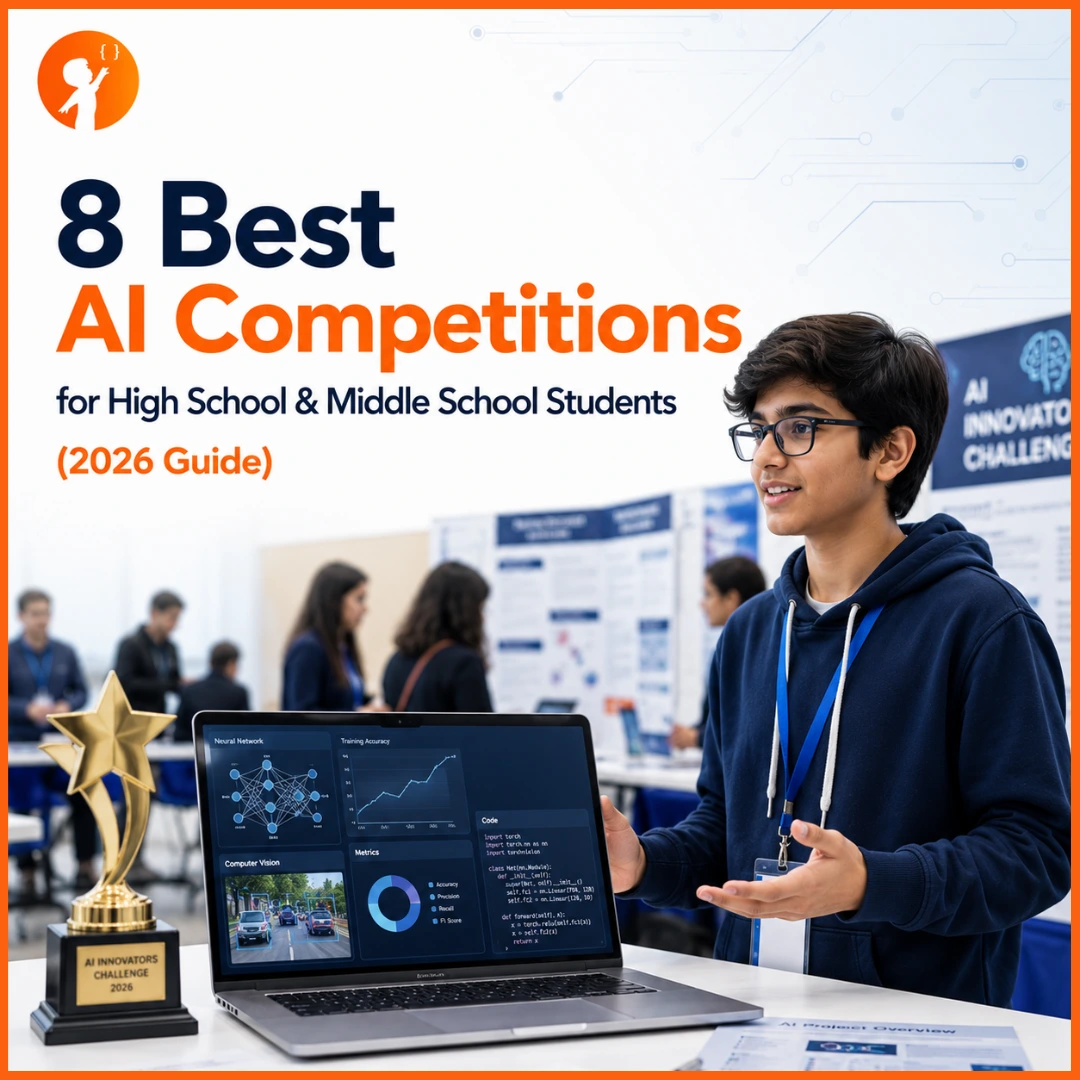
Artificial intelligence and coding aren’t just future skills anymore — they’re something students can compete in, win awards for, and put on a college application today. If your child is curious about tech, entering an AI or STEM competition is one of the best ways to turn that curiosity into real skill, confidence, and recognition.
The challenge is knowing where to start. So we’ve rounded up the 8 best AI competitions for high school students (with several open to middle schoolers too) in 2026 — including the skills and programming languages each one needs, so you can find the right fit. We’ll also show you how your child can build the skills to actually compete. New to all this? Our guide to AI for kids is a gentle place to begin.
Why Enter an AI or STEM Competition?
Before the list, here’s why these are worth the effort. Student AI competitions give kids hands-on experience with real machine learning, coding, and problem-solving — the kind you can’t get from a textbook. They also build teamwork, resilience, and creativity. And on a practical note, universities love them: a genuine competition result shows initiative and passion in a way grades alone can’t. Whether your child dreams of winning a global olympiad or just wants a fun first challenge, there’s something on this list for them.
The 8 Best AI & STEM Competitions in 2026
From elite olympiads like IOAI and USACO to beginner-friendly challenges like WAICY, Technovation Girls, and Imagine Cup Junior, here are eight of the best — each with the ages, skills, and languages it needs, so you can find the right fit for your child.
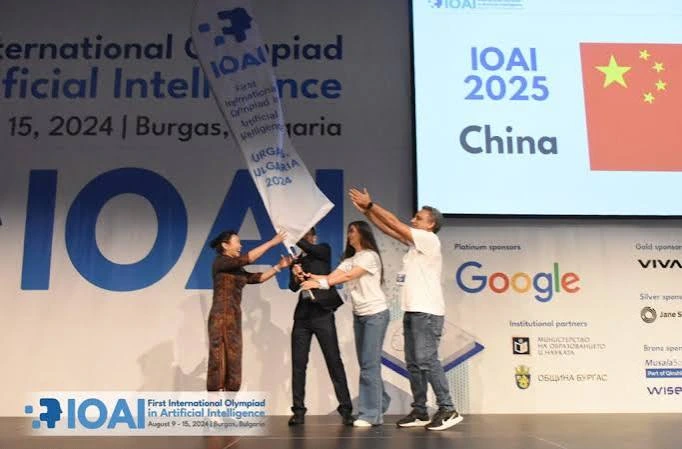
What it is: The newest and most prestigious global AI olympiad, held under UNESCO patronage. Students tackle real challenges in machine learning, algorithms, data analysis, and AI ethics.
Skills needed: Strong machine learning and data analysis, solid maths and logical reasoning, and an understanding of AI ethics — best for experienced students.
Language / tools: Python, along with common machine learning libraries.
Why it matters: This is the “Olympics of AI” — elite and demanding (the 2026 edition takes place in Astana, Kazakhstan), but even preparing for its national qualifiers builds serious AI skills. Ideal for ambitious students aiming for the highest level.
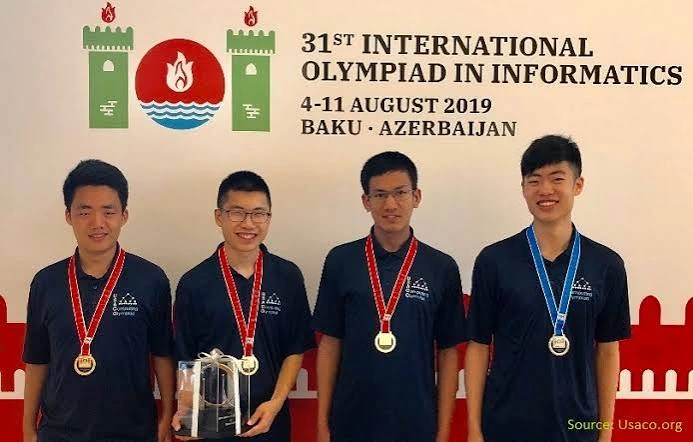
What it is: The premier competitive programming competition in the US, where students solve tricky algorithmic problems across divisions from Bronze up to Platinum.
Skills needed: Algorithms, data structures, logical problem-solving, and mathematical thinking — it rewards consistent practice.
Language / tools: C, C++, Java, or Python (C++ becomes preferred at higher divisions).
Why it matters: USACO is deeply respected by universities and builds genuine problem-solving skill. Because you can’t cram it, coaching helps. At Junior Coderz, our specialised USACO-trained trainers teach to each student’s ability, starting from a solid Python foundation. See our complete USACO Bronze roadmap or meet our USACO trainers.
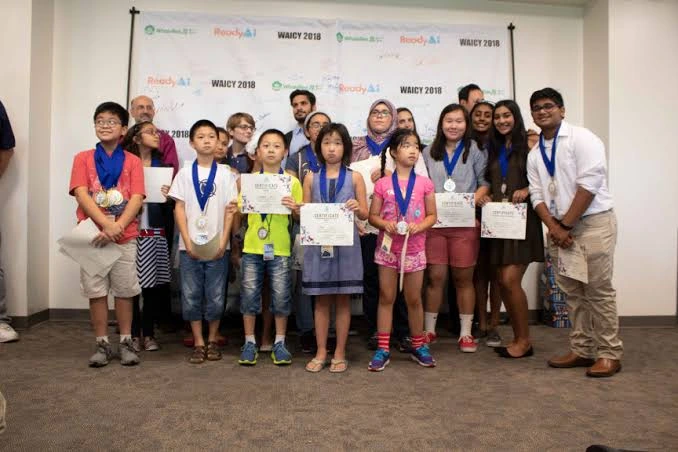
What it is: One of the world’s largest AI competitions for young people, where students design and present their own AI projects across creative tracks like AI showcase, AI-generated art, and AI with large language models.
Skills needed: Basic AI understanding, creativity, and the ability to present a project. Beginner-friendly — no advanced coding required.
Language / tools: Flexible, from no-code AI platforms up to Python, depending on the track.
Why it matters: Far more accessible than a hardcore olympiad. It rewards creativity and real-world impact, so a student doesn’t need to be an expert coder to shine — a perfect first AI competition.
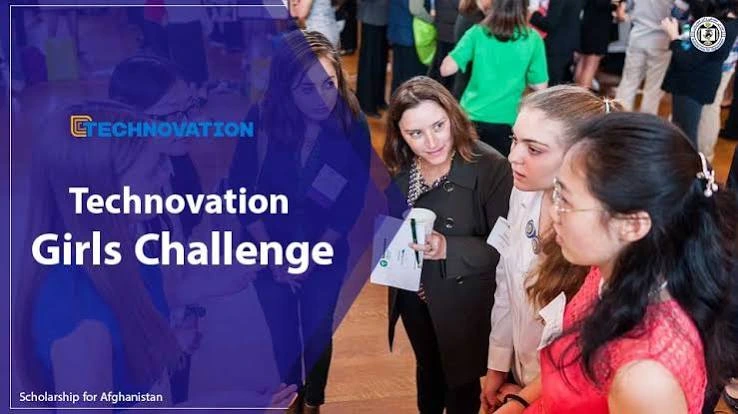
What it is: A global competition where girls build a mobile app (often AI-powered) to solve a real problem in their community, then pitch it like a startup.
Skills needed: App development, AI basics, problem-solving, teamwork, and pitching — no prior programming experience required.
Language / tools: MIT App Inventor or Thunkable (block-based), with the option to integrate AI via App Inventor or Python.
Why it matters: It blends coding, AI, entrepreneurship, and social impact — one of the best ways to get girls excited about tech. Students finish with a real app and a real pitch, brilliant for confidence and college essays alike.
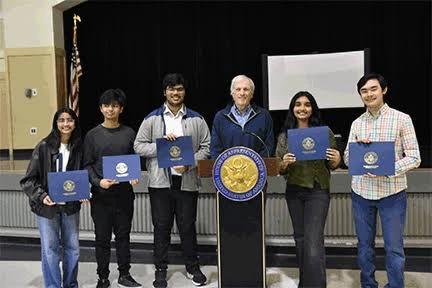
What it is: A US competition, run by members of Congress, where students create an original app of their choosing — many build AI-powered apps.
Skills needed: Coding and app-development basics, creativity, and problem-solving. Beginner-friendly thanks to the district-level playing field.
Language / tools: Any language the student chooses — from block-based tools to Python, Java, Swift, or JavaScript.
Why it matters: Because it’s judged by district, the field is friendlier than a national contest, giving newcomers a real shot. Winning apps are even displayed in the US Capitol — a fantastic first goal, and a great reason to learn to build AI projects.
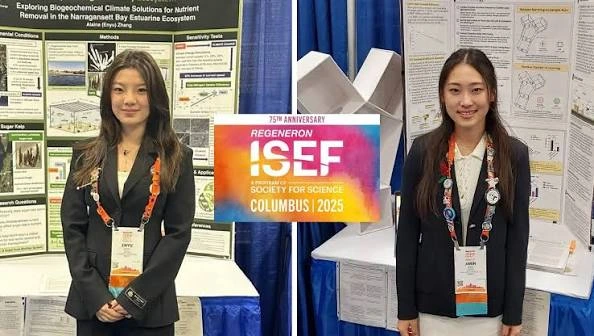
What it is: The world’s largest pre-college STEM research competition, where students present original research — including many projects in AI, computer science, and robotics.
Skills needed: Scientific research and method, critical thinking, and deep knowledge of a chosen topic; AI and CS projects also need data and machine-learning skills.
Language / tools: Depends on the project — AI and CS entries commonly use Python and machine-learning tools.
Why it matters: ISEF is prestigious and carries significant scholarship money and recognition. If your child loves the research side of AI — asking a question and investigating it — this is the pinnacle. It rewards depth, originality, and scientific thinking.
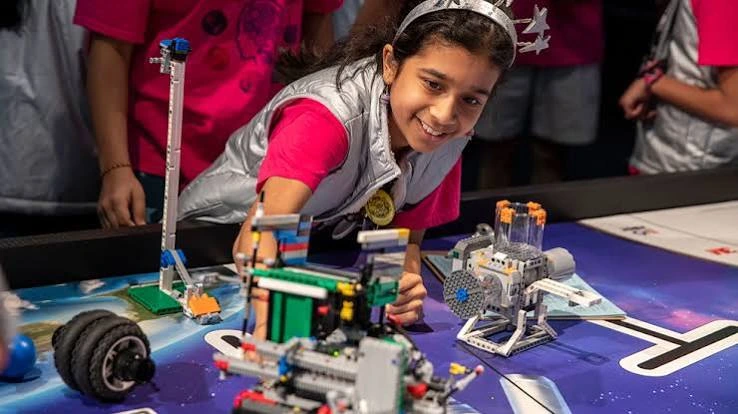
What it is: A family of hands-on robotics competitions where student teams design, build, and program robots to complete challenges — increasingly involving AI and automation.
Skills needed: Robotics, basic engineering, programming, teamwork, and problem-solving. There’s an entry point for every level, including total beginners.
Language / tools: Block/Scratch-style coding for LEGO League; Blocks or Java for Tech Challenge; Java, C++, or Python for Robotics Competition.
Why it matters: FIRST is teamwork and engineering at its best. Students learn coding, robotics, and collaboration while building something real that moves — one of the most beginner-welcoming STEM competitions out there.
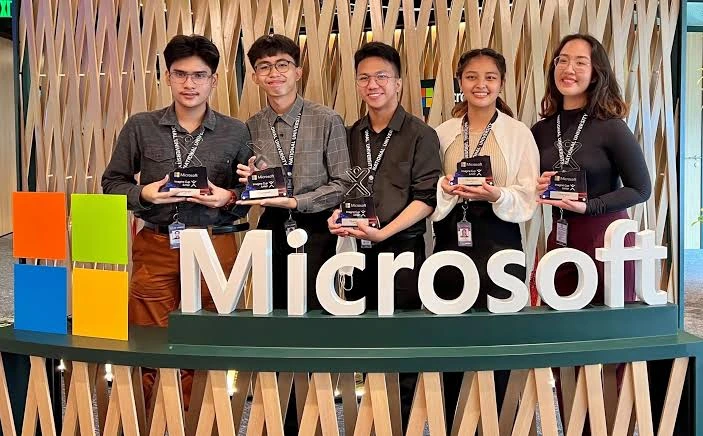
What it is: A global “AI for Good” challenge that introduces students to AI by having them dream up an idea to solve a real-world problem, then present it — no coding required. Younger learners enter a “Tech for Good” track; teens explore generative AI in an “AI for Good” track.
Skills needed: Creativity, an understanding of basic AI concepts, teamwork, and communication. Designed for complete beginners.
Language / tools: No coding needed — students share their concept through a presentation and short video, guided by free AI lessons.
Why it matters: The gentlest on-ramp to AI on this list, focusing on ideas and problem-solving over technical difficulty. For a student curious about AI but not ready for an olympiad, it’s a friendly, confidence-building first step.
Get Competition-Ready with Junior Coderz
Here’s the honest truth about every competition above: the students who do well aren’t the ones who “wing it.” They’re the ones who built real coding and AI skills beforehand — exactly what we help kids and teens do at Junior Coderz.
Through our range of courses — coding, Python, AI and machine learning, robotics, and more — students build the foundation these competitions demand. Not sure whether to start with coding or AI? Our guide on AI vs coding for kids can help, our online AI course takes learners from curious beginner to confident creator, and we cover how to teach AI to kids through real, hands-on projects.
We host our own coding competitions that challenge young coders and celebrate their creativity — from Scratch and Python builds to fresh new formats. And exciting news: we’re arranging a dedicated AI competition soon, giving students a brand-new stage to show what they can build.
Start Building Competition Skills Today
The best time to start preparing for an AI or STEM competition isn’t next year — it’s now. Whether your child is aiming for USACO, dreaming of an AI olympiad, or just wants a fun first challenge, the skills start with the right guidance.
At Junior Coderz, our expert trainers meet students at their level and help them build toward real goals — including competition success. Explore our full courses to find the perfect starting point.
Frequently Asked Questions
Yes. A genuine result in an AI or STEM competition shows initiative, passion, and real skill — qualities admissions officers value highly and that grades alone can’t demonstrate.
Several on this list welcome younger students, including WAICY (from around age 13), Technovation Girls (from age 8), FIRST LEGO League, and Microsoft Imagine Cup Junior (from age 5). These are great, friendly first steps.
It varies. Python is the most common for AI-focused contests like IOAI, while beginner competitions such as Technovation and Imagine Cup Junior use block-based tools or need no coding at all. USACO accepts C, C++, Java, or Python.
Not at all. Competitions like WAICY, Technovation, the Congressional App Challenge, and Imagine Cup Junior are beginner-friendly. Olympiads like IOAI and USACO are more advanced, but everyone starts somewhere — with practice and coaching, students steadily level up.
Yes. Last year we hosted Code Quest 2025, a Scratch and Python competition for young coders, and we’re arranging a dedicated AI competition soon — another exciting opportunity for our students to shine.