Looking for Thanksgiving STEM activities that keep kids busy without another hour of screen time? You don't need special kits. Cranberries, toothpicks, popsicle sticks and a sheet of paper are enough to turn your kitchen table into a small science lab.
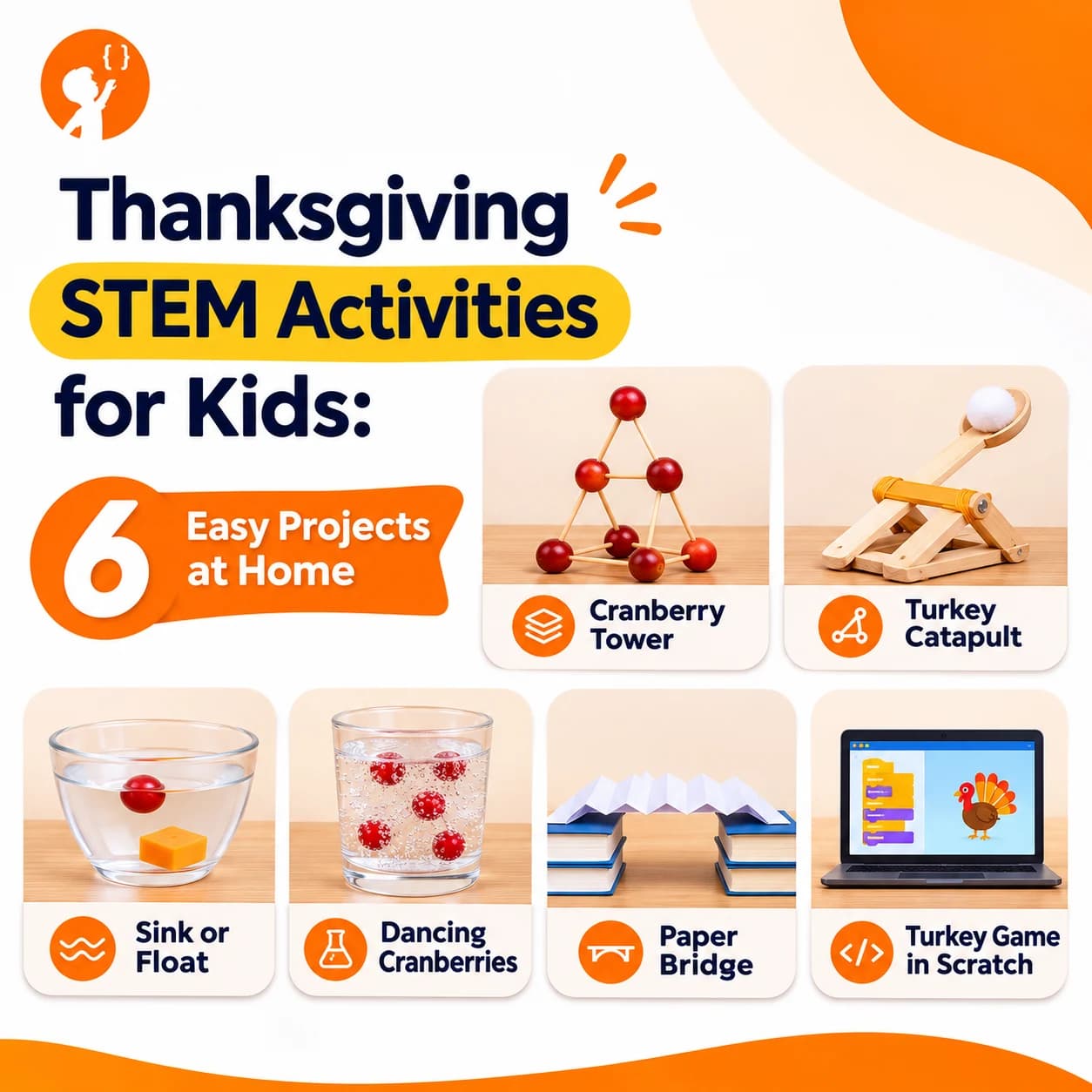
This guide shares six easy projects for different ages. Each one takes under an hour, uses things you probably have at home, and teaches a real idea from science, engineering or coding.
Why Is Thanksgiving a Great Time for STEM?
STEM stands for science, technology, engineering and math, and kids learn these subjects best when they try something, watch it fail and try again. Thanksgiving gives families what a school day often can't: time. With cousins around and a long weekend ahead, a simple challenge feels like a game instead of homework.
| Letter | What it means | A Thanksgiving example |
|---|---|---|
| S: Science | Asking why things happen | Why do cranberries float? |
| T: Technology | Using tools to make things | Coding a turkey game |
| E: Engineering | Designing and building | A cranberry tower |
| M: Math | Measuring and comparing | Counting pennies on a bridge |
6 Thanksgiving STEM Activities for Kids
Here are six activities, starting with the most popular. Use the table to find the right one for your child's age, then follow the steps below.
| Activity | Age | Time | Teaches |
|---|---|---|---|
| Cranberry Tower | 6+ | 30 min | Engineering |
| Turkey Catapult | 7+ | 30 min | Energy and motion |
| Sink or Float | 4+ | 15 min | Density |
| Dancing Cranberries | 5+ | 15 min | Chemistry |
| Paper Bridge | 7+ | 20 min | Design and testing |
| Turkey Game in Scratch | 8+ | 45 min | Coding |
1. The Tallest Cranberry Tower
Of all Thanksgiving science activities, this is the classic. Kids build a tower using fresh cranberries as joints and toothpicks as beams.
You need: a bag of fresh cranberries and a box of toothpicks.
- Push toothpicks into cranberries to make a square, then a triangle.
- Press each shape gently and see which one feels stronger.
- Build as tall as you can before the tower leans.
- Set a challenge: whose tower can hold a small toy on top?
What your child learns: triangles spread weight better than squares, which is why you see them in real bridges and towers. Younger children should work with an adult, because toothpicks are sharp.
2. The Turkey Catapult
Build a small catapult and launch a soft "turkey" across the room. A mini marshmallow or pom-pom works perfectly.
You need: 7 popsicle sticks, rubber bands, a plastic spoon, tape and mini marshmallows.
- Stack 5 sticks and wrap a rubber band around each end.
- Stack the other 2 sticks and band them together at one end only.
- Slide the stack of 5 between the 2 sticks to make a lever.
- Tape the spoon to the top stick, load it, press down and let go.
What your child learns: pressing the stick stores energy, and letting go turns it into motion. Move the stack and see how the launch distance changes. Launch only soft items, and never aim at people.
3. Sink or Float: Thanksgiving Edition
This is one of the simplest Thanksgiving experiments for kids, and it suits preschoolers too.
You need: a large bowl of water and small foods such as a cranberry, a grape, a raisin, a baby carrot and a piece of bread.
- Ask your child to guess which items will float.
- Drop them in one at a time and check each guess.
- Cut a cranberry open and look inside.
What your child learns: fresh cranberries float because they have small pockets of air inside. Making a guess and then testing it is the heart of science.
4. Dancing Cranberries
Dried cranberries seem to dance in a glass of soda. This quick Thanksgiving science experiment looks like magic, but the explanation is simple.
You need: a clear glass, clear soda and a handful of dried cranberries.
- Pour the soda into the glass.
- Drop in the cranberries and wait about a minute.
- Watch them rise, turn over and sink again.
What your child learns: gas bubbles stick to the cranberries and lift them up. At the top the bubbles pop, and the fruit sinks.
5. The Paper Bridge Challenge
Pretend the pie has to cross a river. Using one sheet of paper, build a bridge between two stacks of books and see how many pennies it can hold.
- Lay a flat sheet across the gap and add pennies until it falls.
- Fold a new sheet like a fan and test it again.
- Count the pennies, then try a design of your own.
What your child learns: changing the shape of a material changes its strength. Engineers test, improve and test again.
6. Code a Turkey Game in Scratch
Technology is the "T" in STEM, so end with a project your child can share with the family. Scratch is free, and kids build with colorful blocks instead of typing code.
- Open Scratch and pick or draw a turkey character.
- Make it jump to a random spot every few seconds.
- Add a score that goes up each time someone clicks it.
- Add a 30-second timer and challenge the family.
What your child learns: events, loops and variables, which are core ideas in all programming. For more ideas, see our Scratch projects for kids.
What Skills Do Kids Build From STEM Activities?
The cranberries are only the start. Short projects like these build habits that help children at school and beyond:
- Problem solving: working out why something failed and what to change.
- Patience: trying again after the tower falls.
- Logical thinking: following steps and predicting what happens next.
- Teamwork: sharing ideas with cousins and siblings.
How Can You Make STEM Fun, Not Homework?
How you run the activity matters as much as the activity itself. These small habits keep it playful:
- Let them fail. A falling tower teaches more than a perfect one.
- Ask instead of explaining. Try "Why do you think that happened?"
- Make it a contest. Cousins love competing for the tallest tower.
- Use what you have. For more ideas, try our hands-on STEM activities.
How Do You Run These With a Big Group?
Thanksgiving often means a house full of children of different ages. Split them into mixed-age teams, so older kids can help younger ones. Give every team the same supplies and a 15-minute timer, then test each design together. Keep toothpicks with the older children, and let the youngest handle Sink or Float.
How Junior Coderz Turns Curious Kids Into Creators
If your child enjoyed building, testing and fixing things, they already think like a programmer. At Junior Coderz, kids take that curiosity further in live online classes taught by engineers.
Children start where it suits their age and grow from there:
- Scratch coding for younger beginners who love making games and animations.
- Python for older kids who are ready for typed code.
- Robotics and electronics for hands-on thinkers who like to see how things work.
Turn Holiday Curiosity Into Real Skills
Junior Coderz helps kids go from weekend experiments to real coding projects, in live classes they look forward to. Your child learns with a friendly tutor who follows their pace, builds games and animations, and gets help the moment they feel stuck. Book a free trial class and see how much they enjoy learning this way.
- Free Trial Class
- One-to-One Online Learning
- Expert Tutors and Live Interaction
Moving Forward
The best Thanksgiving STEM activities don't feel like lessons. A tower of cranberries or a flying marshmallow can teach real engineering, science and coding, and give your family something to laugh about too. Pick one activity this year and let your child lead. When they're ready for more, Junior Coderz is here to help, and you can see what students build on our Instagram page.
FAQs
What are easy Thanksgiving STEM activities for preschoolers?
Sink or Float is the easiest, because it only needs water and food from your kitchen. Dancing Cranberries also works well with an adult helping.
What is a good Thanksgiving science experiment for a big group?
The Cranberry Tower works best. Split kids into teams, give each team the same supplies and set a 15-minute timer.
Do these STEM Thanksgiving activities need special materials?
No. Almost everything is already in your kitchen or craft drawer, and fresh cranberries are easy to find in November.
What age are Thanksgiving STEM activities for kids best suited to?
These projects cover ages 4 and up. Younger children do well with Sink or Float, while kids aged 8 and over can try coding a turkey game in Scratch.