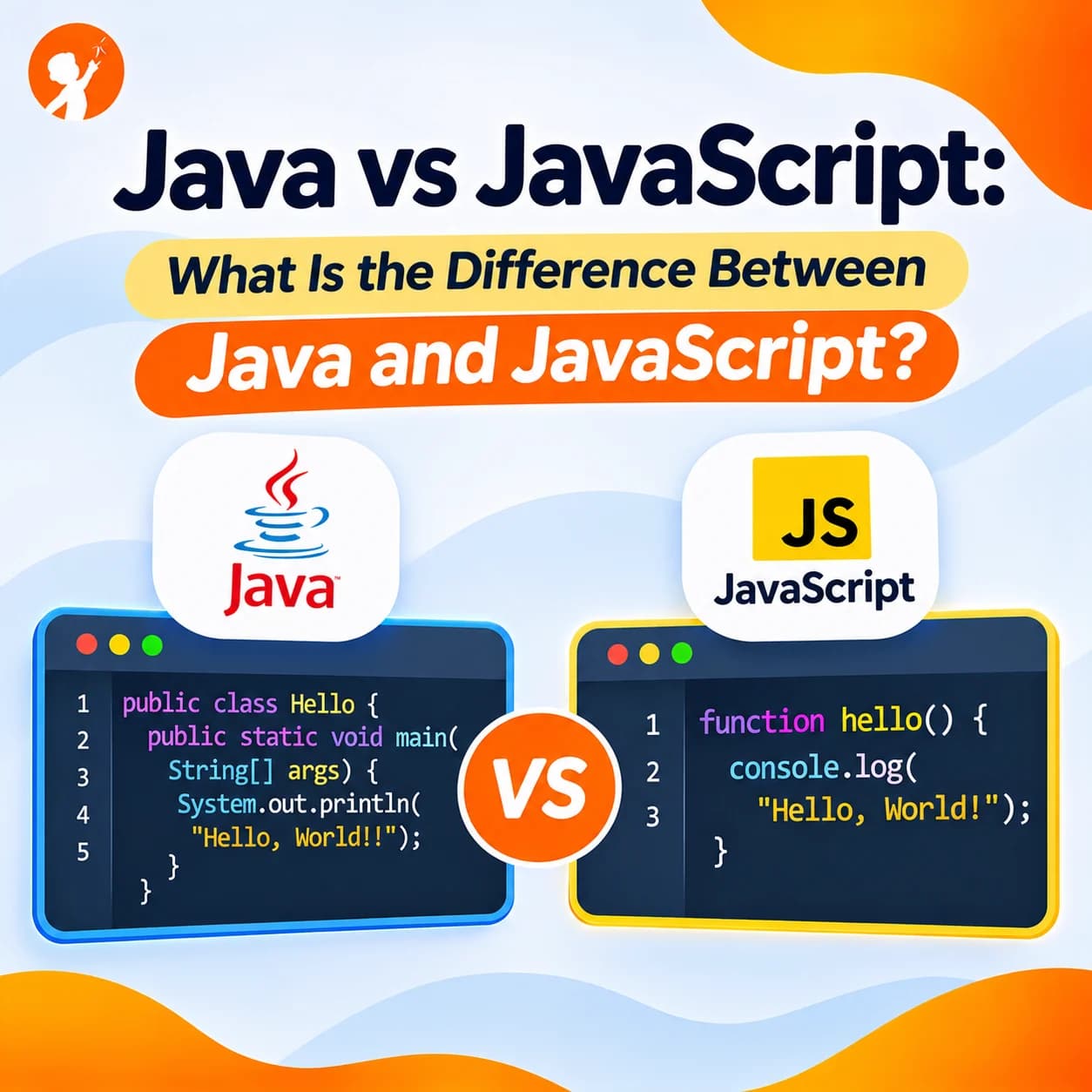
What is the difference between Java and JavaScript? Despite the similar names, they are two completely different programming languages, built by different companies for different jobs. A popular joke says Java is to JavaScript what a car is to a carpet: the names share a few letters, and that's about it.
This guide explains what each language is, how they differ, what each one is used for, and which one a child or teen should learn first.
Why Do Java and JavaScript Have Similar Names?
Java was released by Sun Microsystems in 1995 and quickly became one of the most popular languages in the world. In the same year, a programmer at Netscape created a small language to make web pages interactive. It was first called Mocha, then LiveScript, and was finally renamed JavaScript, partly to ride on Java's popularity. The name stuck, and people have been confusing the two ever since. Today they are run by different groups, follow different rules and are used for very different things.
The Key Differences Between Java and JavaScript
Here are the most important differences, explained simply.
1. Where They Run
JavaScript was made for the web. It runs inside every web browser, such as Chrome, Safari and Edge, so you can start writing it right away with no installation. Java runs on the Java Virtual Machine (JVM), a program installed on a computer, phone or server, which lets the same Java code work on many devices.
2. What They Are Used For
JavaScript makes websites interactive: menus, buttons, animations, forms and browser games. With tools like Node.js, it also runs servers and apps. Java powers Android apps, large business systems, banking software and games like the original Minecraft: Java Edition.
3. Compiled vs Run Straight Away
Java code is compiled first: a tool turns it into a special form called bytecode before it runs. JavaScript is usually run straight away by the browser, line by line, which makes it quick to test small changes.
4. Strict vs Flexible Variables
In Java, you must say what type of data each variable holds, such as a whole number or text, and that type cannot change. JavaScript is flexible: a variable can hold a number now and text later. Java's strict rules catch many mistakes early, while JavaScript's flexibility makes it faster to write small programs.
5. How the Code Looks
Here is the same "Hello" program in both languages. Notice how much shorter the JavaScript version is.
Java:
public class Main {
    public static void main(String[] args) {
        String name = "Sara";
        System.out.println("Hello, " + name + "!");
    }
}
JavaScript:
let name = "Sara";
console.log("Hello, " + name + "!");
6. Classes and Objects
In Java, almost everything lives inside a class, so programs are very structured from the start. JavaScript also supports classes, but you don't have to use them, which makes it easier for beginners to write small scripts.
Java vs JavaScript at a Glance
| Feature | Java | JavaScript |
|---|---|---|
| Created by | Sun Microsystems (1995) | Netscape (1995) |
| Runs on | Java Virtual Machine (JVM) | Web browsers, and servers with Node.js |
| Main uses | Android apps, business software, servers, games | Interactive websites, web apps, browser games |
| How it runs | Compiled to bytecode first | Usually run straight away by the browser |
| Variable types | Strict (fixed types) | Flexible (types can change) |
| Setup for beginners | Needs Java installed | Nothing to install: just a browser |
| Code length | Longer and more formal | Shorter and quicker to write |
What Java and JavaScript Have in Common
They do share a few things. Both use curly brackets { } and semicolons, and both have if-statements, loops and functions that look quite similar, because both borrowed ideas from the C language. Both are among the most used languages in the world, and both have huge communities, so help and tutorials are easy to find. Once you learn one, the basic ideas make the other much easier to pick up.
Which Should a Child Learn First: Java or JavaScript?
For most beginners, neither is the very first step. Young children usually start with block coding, such as Scratch, then move to Python, whose clean code is the easiest way into text programming. After that, the choice depends on what your child wants to build:
- Loves websites and design? Learn HTML and CSS, then JavaScript. Results appear instantly in the browser, which is very motivating.
- Wants to make Android apps or Minecraft mods? Java is a great choice.
- Interested in coding competitions? Java is one of the languages accepted in contests like USACO, along with C++ and Python.
- Thinking about computer science at school or university? Java is widely taught, for example in AP Computer Science A.
For a wider view, read our guides to the best coding languages for kids and what computer programming is.
Fun First Projects in Each Language
| JavaScript projects | Java projects |
|---|---|
| A button that changes a page's colour | A number-guessing game in the console |
| A to-do list web app | A simple calculator |
| A quiz website with a score | A text adventure game |
| A simple browser game, such as Snake | A basic Android app |
Want to start with the web? See our guide to website creation for kids.
Learn Real Coding Languages With Junior Coderz
At Junior Coderz, children and teens aged 6 to 16 learn coding in live online classes with trained engineer instructors, following a clear path from blocks to real languages. Beginners start with Scratch, then move to Python. Teens who love the web learn HTML, CSS and JavaScript in our web development classes, and students aiming for competitions can join our USACO training. See all options on our courses page.
Not Sure Which Language Is Right for Your Child?
Book a free trial class and let one of our engineer instructors find the best starting point. Your child builds a small project in a live lesson, and you get honest advice on whether Scratch, Python, JavaScript or Java fits their age and goals. There is no pressure and nothing to install.
- Personal Level Check
- Engineer Instructors
- Ages 6 to 16
Two Languages, Two Great Paths
Java and JavaScript may share a name, but they lead to different places: JavaScript to the web, and Java to apps, big software and competitions. Neither is "better"; the right one is the one that matches what your child wants to build. Start with the basics, pick a project that excites them, and the language will follow. To see what young coders are creating, visit Junior Coderz or follow us on Instagram.
FAQs
Is JavaScript the same as Java?
No. They are separate languages with different rules and uses. JavaScript mainly runs websites, while Java is used for Android apps, business software and servers.
Is Java or JavaScript easier to learn?
Most beginners find JavaScript easier to start, because it runs in any browser and needs less code. Java takes longer to set up but teaches very solid habits.
Can I learn JavaScript without knowing Java?
Yes. You don't need any Java to learn JavaScript. Many people learn HTML, CSS and JavaScript as their first languages for the web.
Is Minecraft made with Java or JavaScript?
Minecraft: Java Edition is written in Java, which is why many young coders learn Java to make Minecraft mods.
Which pays more, Java or JavaScript?
Both lead to well-paid careers. Java is common in large companies and Android development, while JavaScript is used by almost every website.
At what age can kids learn Java or JavaScript?
Most children are ready for JavaScript or Java from around age 12, after some experience with Scratch or Python.